Wednesday, March 2, 2022

In Praise of Used Bookshops

This is a re-post that was originally part of the 2014 book release blog tour, hosted by Sirens of Suspense (RIP). 

Thank you, Sirens of Suspense, for the opportunity to drop by on my February blog tour for The Kept Girl, a novel of 1929 starring the young Raymond Chandler, his devoted secretary and the real-life cop who is a likely model for Philip Marlowe.


With this guest post, I'd like to send a little virtual love note out to the used bookshops of the worldthe long, narrow ones with high shelves and dust and cats and grumpy clerks and little stashes of rarities that some poorly-behaved customer has tucked away behind the automotive repair guides with the vague intent of purchasing when their monthly check arrives.


There aren't very many used bookshops left these days, and I think we should all strive to patronize the ones that are still hanging on. The internet has democratized the book collection hobby, making it all too (relatively) cheap and easy to amass every Dell map back mystery, or those sly Edward Gorey Anchor Books paperbacks, or whatever special patch of print history it is that makes your pulse race. 


But the downside of the internet is that, while it's very good at delivering the things one already knows they're interested in, it tends to run thin in true surprises.


And it's those true surprises, jaw droppers and head shakers, in which the best bookshops have ever traded, and that make them such valuable spaces in our shared cultural life. 


Take, for example, the one rare little document that gave off the sparks that burned and flared into my debut novel, The Kept Girl. 



I didn't even find it myself. My '90s zine pal Lynn Peril of Mystery Date fame–that's her on the cover of the RE/Search book Zines! Vol. One–was roaming the aisles of Kayo Books in San Francisco's Tenderloin, a paperback collectors' store specializing in pulp exploitation and oddities, when she noticed a slim pamphlet tucked up on a shelf. Even before picking it up, she could see it was too thin to be a mass market title, and the wrong size for a cheap recipe book. There was no writing on the spine, there wasn't even a spine. It was something unique, a one-off. Curious, she picked it up.
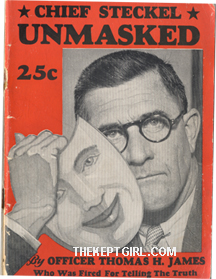


As it happened, Lynn had found the self-published
 j'accuse of a fired Los Angeles cop, tossed off the force in 1931 because he couldn't help notice that the Mayor and Police Chief were up to their navels in rum running, drugs and the flesh trade, and because he couldn't seem to shut up about it. 


Los Angeles crime lore isn't really Lynn's beat, but for $5, Chief Steckel Unmasked (originally priced at 25¢, with the penciled notation "Read and pass on") was too interesting to leave behind. She bought it, took it home, and some time later asked me if I'd like to see it. Would I! 


Chief Steckel Unmasked is one incredibly peeved ex-cop's and Police Commission investigator's cry into the darkness of a sun-drenched city gone foul to its roots. He names names, calculates illegal profits, gives the addresses of whole streets packed with houses of ill fame, and ultimately calls on the righteous population of Los Angeles to rise up and reclaim their community from the elected gangsters that control it.


Reading it, I felt a weird twinge. Los Angeles crime lore is my beat, but I'd never heard of this guy. Yet he seemed to know where all the bodies were buried, and to be completely fearless. I turned to the historic Los Angeles Times archives, where a rich history revealed itself.


Thomas H. James was a the foster son of a wealthy leader of the Women's Christian Temperance Union. He went into police work to help his fellow man, and campaigned for Mayor Porter, impressed by promises of reform. Porter won, and installed Tom James as his personal police commission investigator. 


Disillusioned at the state of the city, and to by Porter's true colors, James started preaching reform. They bounced him down to beat cop at a busy downtown intersection. He didn't stop. They sent him into the deep San Fernando Valley, where the chicken ranchers were. He kept squawking. They fired him, and he wrote and published this little book, sued to get his job back, and within a decade saw the recall of crooked Mayor Frank Shaw. (The reform of the LAPD would take a little longer.) 


Aspects of Tom James' life and character reminded me strongly of Raymond Chandler's white knight detective Philip Marlowe. After leaving City Hall under a cloud, uniformed James preached reform two blocks east of Chandler's oil company offices, and was the talk of the town in 1929. Later, James was enmeshed in a notorious shooting that Chandler would fictionalize in the transitional Black Mask story "Spanish Blood." Could Chandler, who drew on real crimes for his plots and real buildings for his scenes, have looked to a real reformer when creating his detective hero?


That idea was the spark that would burn and flare, as more research was packed around it, until I saw a way to tell Tom James' fascinating story, and the young Chandler's, and that of the sad and deluded people who fell victim to a strange cult of angel worshippers called The Great Eleven, all in one neat little mystery. 


As the puzzle pieces came together, I leaned in and tucked them in tighter. It felt kind of magical, as if the story was meant to be told just this way. And it's a book that might never have happened had my friend not spied that odd little pamphlet on the shelf and passed it on. 


So let's hear it for those wonderful used bookshops, where surprises lie in wait until the right person comes along and notices them. Long may they trade!

Sunday, January 30, 2022

The Case of the Spectral Headache


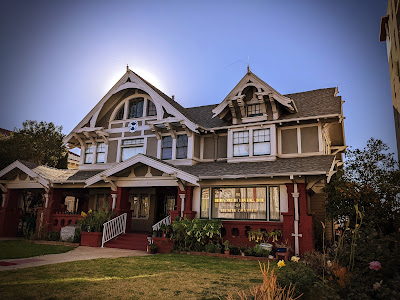
On the occasion of the announcement that the archives of the Woman’s Christian Temperance Union of Southern California are no longer stored in an old Craftsman mansion in Koreatown, but are now in the care of the Willard House Museum & WCTU Archives in Evanston, Illinois, I'm republishing this post that was part of the 2014 book release blog tour, hosted by Drey's Library. 

While I'm pleased that this material will be properly organized, protected from the elements and accessible to scholars, it's always sad when a local archive leaves Southern California. 

Something my husband Richard Schave and enjoy as a side effect of our work researching Los Angeles lore is to help steer historic documents into institutional archives, including a previously unknown rendering of the National Register Bradbury Building. Maybe we would asked the nice WCTU folks about their plans, had our one visit to view the material in 2012 not resulted in a rather nasty supernatural experience. We held off returning for four years, only to be told they were packing up most of the collection for the move east.  

Read on for The Case of the Spectral Headache...

The Kept Girl is based on a real Los Angeles cult murder investigation of the late 1920s, and most of the characters in the novel are based on actual people. In order to portray them accurately, a lot of research had to be done before I could start writing. 

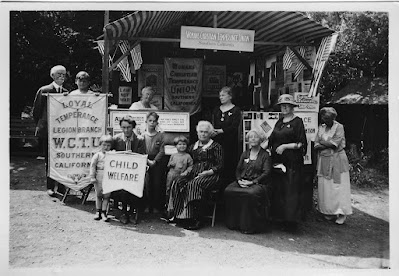
One of my three detectives is LAPD officer Tom James, who was the foster son of Allie Wheeler, a prominent member of the local branch of the Women's Christian Temperance Union (WCTU), a lobby group that sought to ban alcohol consumption in America.  Tom lived in his foster mother's home, and they were politically active together. 

I knew a bit about the WCTU's work on a national level, but not much about the local organization. So I was delighted to discover that the WCTU still maintains a presence in Los Angeles, with offices in a charming old Craftsman house in the very neighborhood where much of my novel is set. Better still, one of their members maintains an archive, and would be happy to let interested researchers come in and consult it.

An appointment was made for a small group of Los Angeles history fiends to visit the WCTU headquarters, where we spent a fascinating afternoon in good company, learning about the organization's history and looking through old books, photographs and memorabilia, including a marvelous creepy automaton figure that promotes sobriety at the County Fair. 

Here is video of another WCTU automaton figure, similar to the one in Los Angeles.

I even found a photo of Allie Wheeler as a young woman. All in all, a most successful day in the archives!

Or so I thought, until that evening, when I decided to unwind with a small glass of wine. A few sips from the glass and it hit me—a headache like I have never felt before in my life. Located behind my left eye, it felt as if an angry child was trying to dig that eye out of my head with a grapefruit spoon. 

Left eye shut against the light, sweating, I managed to do an internet search for my symptoms and determined it was almost certainly a cluster headache, an extremely rare form of migraine, and that nothing much could be done except wait it out. 

I am not a migraine sufferer, but here I was, having hours before opened the Pandora's Box of the WCTU archives and thoughtlessly celebrated with a snoot full, struck down with the very worst sort of migraine, the one colloquially called a "suicide headache."

I huddled on the couch for hours, with an ice pack clutched to my neck. It was terrible. Then, after midnight, merciful sleep.

I felt physically fine in the morning, but mentally shaken. I told Richard what had happened, and he immediately blamed my experience on an elemental force freed when I had stirred up the spirits of temperance activism. He suspected that this elemental had followed me home, and didn't like me taking a drink.

Maybe he was right. All I knew was, I had a book to write, and didn't dare risk another cluster headache. I stayed sober for many months. There were no more headaches. I wrote a rather funny scene in which a large group of WCTU ladies help my detectives Tom James and Raymond Chandler with their case, while politely ignoring the fact that Chandler is clearly hungover from the night before.  

I don't know what happened that night the cluster headache came upon me, if Allie Wheeler and her friends had anything to do with it or if was just an odd coincidence. But the intensity of the pain drove home to me just how intense were the belief systems of the people I was writing about—not just the temperance activists, but also the cultists who had their headquarters just six blocks away from the archive. 

All of these people are decades dead, but here I was stirring up their passions, fictionalizing their appearances, reviving their relationships, putting words in their mouths. It was serious work, and had to be approached with respect. I left the liquor cabinet doors closed, and took up my pen, determined to do right by these old citizens of my city. I like to think they'd be pleased with the results, and if they're not, I hope they'll make that known in a gentler way than the last message from beyond. 

Southern California WCTU Booth (Frances Willard House Museum and WCTU Archives)


Tuesday, October 6, 2020

Introducing Esotouric's Historic Los Angeles Webinars, with Raymond Chandler & The Black Dahlia

Due to the public health crisis, Esotouric, the tour company I run with my husband Richard Schave, has halted all in-person programming, including the quarterly Raymond Chandler sightseeing tour with its section about the Great Eleven cult and the real life characters who figure in The Kept Girl.


But for the first time, we’re taking the immersive Esotouric experience online, with a new series of Saturday webinars. These illustrated lectures feature rare views of Los Angeles landmarks and unpublished archival discoveries, illuminating the secret histories of the city we love.

This Saturday at noon Los Angeles time, I’ll be co-hosting the webinar Black Dahlia Days: Sleuthing out Beth Short’s Southern California. The unsolved 1947 murder has an unusual Raymond Chandler connection, with the victim’s nickname derived from Chandler’s screenplay for The Blue Dahlia. If you can't watch live, the recording will be available for a week.

And next Saturday, October 17, we’ll be devoting the program to Raymond Chandler himself, and the surprising new discoveries that we’ve made over thirteen years of hosting a tour about the author and digging in archives for fresh ways to tell his uniquely Los Angeles story. 

We hope you’ll join us for a virtual visit to old Los Angeles. Other webinars in the series include Inside the Bradbury Building and Inside the Dutch Chocolate Shop.

And if you’d like to keep up with the latest in Los Angeles historic preservation and culture, as well as upcoming webinars, our free weekly newsletter is available when you click the "none" button here

Sunday, July 28, 2019

Presenting: Cults! Mad, Bad and Dangerous to Know, A Guide To The Highly Unusual


I'm pleased to announce the release of Cults! Mad, Bad and Dangerous to Know: A Guide To The Highly Unusual, my third title from Herb Lester, the stylish London-based publishers of travel guides and maps too pretty to make notes on.

The gorgeous black on bronze artwork is by Brian Rau, who in another lifetime definitely produced banners for secret societies and tent revivals.

Included in the packet are two blank postcards and a fold-out map of North America marking the spot of 30 memorable cults, with an inset section highlighting Southern California's incomparably oddball assemblies.

On the flip side, I boil down each organization to its essential spiritual or criminal tenets, because praemonitus, praemunitus (forewarned is forearmed) when it comes to such dangerously attractive characters as The Great Eleven, Manson Family, Buddhafield, Heavens Gate, Synanon, NXIVM, People's Temple, Rajneesh, Process Church and ISKCON New Vrindaban Community.

In 2016, Herb Lester published How To Find Old Los Angeles, my pocket guide to 153 delightful places where the past is present. In 2014, I wrote the words to accompany Paul Rogers' fold-out Raymond Chandler Map of Los Angeles. All three publications, as well as my novel The Kept Girl (also with artwork by Paul Rogers), are available as a souvenir when you join us for an Esotouric sightseeing tour, or from Esotouric by mail. You can also find the new Cults guide wherever fine printed matter is sold, on Amazon or the bookstore supporting Bookshop site, and direct from Herb Lester.

From my Cults guide introduction: We’ve all seen them: those tight-knit groups of fellow travelers, dressed in matching colored robes, shaking the can or passing out literature on street corners, smiling at some shared and secret observation. Cults are fascinating, even as we try not to look at them too closely. But when we do take a look, we find that like Tolstoy’s happy families, cults are almost all alike. Take a big dollop of unresolved daddy (or mommy) issues and shake them up with physical isolation, a leadership hierarchy, mental manipulation, financial exploitation and sexual abuse, and you’ll have the standard Cult Cocktail, ready to be garnished with unique beliefs to taste. Often, the first layers of membership are wonderful, providing the deepest sense of belonging that a lonely seeker has ever felt. It’s only as the onion is peeled that the real community is revealed, and often then it is too late. We’ve collected thirty of the more interesting recent cults to stake a claim in North America, and boiled their complex histories down to bite size. Each one is an extraordinary example of how a whole new world can coalesce around charisma and faith, and how mad, bad and dangerous these worlds can be to know.

To get your copy: click here, or join us on a tour.


Wednesday, November 28, 2018

Noir News: The Kept Girl rubs shoulders with Hammett and Cain


The Workman & Temple Family Homestead Museum in the City of Industry is hosting a Birth of Noir book club series early next year, and I'm very honored that The Kept Girl is sandwiched between two giants in the genre: Dashiell Hammett's The Maltese Falcon and James M. Cain's Double Indemnity. Here's a link to the Facebook event page.


Hammett and Cain are regrettably indisposed, but I'm always keen to visit the Homestead Museum, home of two historic houses and a marvelous walled Victorian private cemetery where Pio Pico spends eternity (above). So my husband Richard Schave and I will be attending the March 20, 2019 Homestead Museum Book Club meeting on The Kept Girl, to answer questions about the book and the Raymond Chandler bus tour that inspired it. Perhaps you'll join the club and soak up some new and classic noir fiction, and we'll see you there.


Friday, September 28, 2018

Celebrating "The Annotated Big Sleep" at Skylight Books


Crackle, crackle!


It sounds like old time radio, but it's actually a recent recording from The Annotated Big Sleep book launch event at Skylight, featuring the editors and Judith Freeman, David Ulin, Steph Cha, Gary Phillips and our own Kim Cooper (starting around 0:36:25).

Wednesday, March 14, 2018

Touring The NoMad Hotel, or... The Bank of Italy is alive, alive!


Three years ago, on the occasion of the announcement of its sale, I wrote a post entitled "A Conjurer's Guide to Lost Los Angeles" about the derelict Bank of Italy building (above), and how I'd had to rely on vintage photographs, stray glances through dirty windows and my imagination to use it as a setting in The Kept Girl.

Since that time, the Downtown landmark where Raymond Chandler worked as an oil executive has been lovingly restored and creatively reimagined for its new life, not as a bank and office building, but as a high-end NoMad hotel, with several restaurants and bars within.

Last week, I had the opportunity to finally set foot inside the building that holds such a particular place in my heart, as Carolyn Schneider, NoMad's Director of Guest Experience, graciously gave a tour of the public and private spaces.

My first reaction on stepping into the ornate lobby was to stop dead and make a joke about experiencing Stendhal Syndrome. But I wasn't entirely joking: it was startling to see in full, glorious color the elaborate ceiling that I know so well from the black and white images from opening day 1923. Time travel should be disorienting.


But there was more to see and no time for swooning. Come with me on a walk through a landmark brought back from the dead, through the subtle restoration work of Killefer Flammang Architects and the stylistic flair of interior designer Jacques Garcia.

As I explored, the burning question on my mind was: does Raymond Chandler's spirit still linger within? Answer: could be! Read on to see for yourself.
The historic basement vault is repurposed as public restrooms.
Locking wheels on the back of the vault door.
Emerald curtains hang in the mezzanine (originally the ladies banking department).

Looking down from the mezzanine to the 7th Street doors.
Jewel tones and fine finishes show great respect to the building's elegant bones.
While writing The Kept Girl, I agonized over the location and appearance of these elevators. 
A ship detail on the elevator door evokes the golden age of Italian exploration .
The view of 7th & Olive Streets from a corner room.
Looking north from the rooftop at James Oviatt's Art Deco penthouse and elevator tower. 
The once utilitarian roof now has a pool with a weird
fireplace inspired by the Italian Mannerist Gardens of Bomarzo.
Windows gaping, for years the building was home only to pigeons.
It seems they still think of it as home.
Spotted on the mezzanine: a framed copy of a 1970s motion picture tie-in edition of
Raymond Chandler's The Big Sleep. (Bob Mitchum is Philip Marlowe.) 
The author, mid-swoon, looks forward to returning.

Tuesday, August 29, 2017

Kept Girl Kept Days book sale - ebook and Paperback editions (8/29 - 9/4)

When I plotted The Kept Girl, I chose to set the action over seven sweltering summer days in late August/early September, 1929.  

To commemorate the fourth occurrence of this literary anniversary since publication, the ebook edition is on sale for .99 cents direct from Esotouric.   

Not an ebook reader? Save $5 off the paperback in the Esotouric Shop with the discount code "asmartgirl".  

Read Chapter One to get a taste, and see some reviews here. I hope you'll take advantage of the Kept Days Sale (August 29 - September 4, 2017)--and please, tell a book-loving friend.

Sunday, July 23, 2017

The clews from Raymond Chandler’s war

Decades after his death, and with a shelf full of biographies, Raymond Chandler still hasn’t given up the last of his secrets. 

I know, because my own Chandler research sent me down the rabbit hole that ended in discovery of The Princess and the Pedlar, a comic operetta in the style of Gilbert and Sullivan that Chandler wrote in collaboration with Julian Pascal, the husband of Cissy, the woman who would become Chandler’s wife and lifelong muse.

The operetta was finished, or close to it, in summer 1917, when Chandler resigned his bookkeeping job at the Los Angeles Creamery and travelled to Vancouver. 

There he volunteered for the Canadian Expeditionary Force, which offered him a starting weekly benefit of $15, which he assigned to his mother, Florence. The money was sent to her new Los Angeles address, at 127 South Vendome Street, the residence of Julian and Cissy Pascal.


There was room for a boarder at 127 Vendome, because Gordon Pascal, Julian’s 20-year-old son by a previous marriage, also joined the CEF. He stood as his best friend Ray’s witness, and Ray his, as each took the oath of faith and allegiance to King George V, His Heirs and Successors. Gordon, British born, likely meant it, but I wonder if Ray was just going through the motions. But  in signing up, he ensured his mother’s support, and his own absence from a personal situation that had apparently become untenable.  


It’s startling to think of Raymond Chandler, whose brain would give us Philip Marlowe and so many deathless observations about Los Angeles, crossing the Atlantic to serve as cannon fodder in the war to end all wars. But there it is in elegant ink on Manila paper: Chandler, Raymond Thornton, Private in the 50th Regiment Reinforcements. 

And also, the declaration that he did not know if his father, the drunken Quaker railroad man who had abandoned the family and set Chandler on his own weird, stateless path, was alive or dead. (Maurice Chandler was in fact, still living.)


Private Raymond Chandler might so easily have died himself. Not just in battle, although the war was terrible for the Canadian Expeditionary Force, but of illness.

And indeed, his recently digitized military records reveal two bouts with influenza during the peak of the deadly pandemic. 


Chandler was sent to the infirmary twice in England, in July and October 1918. Each time, he recovered after six days. Millions of young people were not as hardy. Among the artists who succumbed in Europe, the painter Egon Schiele died October 31, 1918, poet Guillaume Apollinaire nine days later. 

Chandler was not previously known to be a survivor of the Spanish Flu, and I have added his name to Wikipedia’s list of notables who fought off their infection.

It’s interesting to note that his medical records show no affection of the Genito Urinary system, that is no infectious hangovers from the erotic adventures typical of soldiers facing death. His apparent chastity supports the theory that Chandler went to war because he was in love with Cissy and didn’t want to break up the Pascal marriage. 

There is another surprise to be found in Chandler’s wartime records. With my discovery of The Princess and the Pedlar, it wouldn’t be too unexpected if this full-time bookkeeper and amateur librettist chose to give his peacetime occupation as “writer” or “playwright.” 


But at the induction center in Vancouver, Raymond Chandler proudly declared himself to be a Journalist. 

It was in this analytic mindset that he set off on the great and terrible adventure that shaped his life in ways we will never know. But it is only from war that could come understanding of the deep masculine friendships that make The Long Goodbye his greatest book. The self-destructive drinking, the inability to handle stress and creative deadlines, may have had their roots here, too. 

And most profoundly, the decision to return to Los Angeles—to break up the Pascal marriage and to take gallant responsibility for the older, infirm Cissy until death did they part—must have been made in Europe. 

Perhaps he decided in the enlisted men’s infirmary in late October, returning to consciousness after days of delirium, and realizing that no matter how hard he tried, he wasn’t going to die young and heroic on a foreign shore. 

There was something bigger waiting for him among the palm trees and the oil seeps. So Raymond Chandler went home.


Written on the occasion of the writer’s 129th birthday, at El Sereno, Los Angeles

Friday, February 3, 2017

Kim Cooper on the Secret Library Podcast: weird crime, Raymond Chandler, archives & induced hallucinations

I was honored when Caroline Donahue recently invited me to appear on her literary podcast, The Secret Library, a congenial place where writers can let their hair down for an audience of readers and fellow scribes. 

Episode 36 is out now, featuring a wide-ranging conversation about using historic crimes and personalities in fiction, the subscription publishing model, research methods, channeling the voices of Raymond Chandler and his friends through induced hallucinations, historic preservation, the weird side of Los Angeles and more.

Give a listen on the podcast page or over on iTunes.

Tuesday, September 20, 2016

Presenting: How To Find Old Los Angeles, a guidebook to the city that was... and still is!

I'm pleased to announce the release of How To Find Old Los Angeles, my second title from Herb Lester, the stylish London-based publishers of travel guides and folding maps too pretty to make notes on. Included are 153 historic places that will delight any seeker of cool, old Los Angeles.

Two years ago, I had the great honor to be asked to write the text for Paul Rogers' fold-out Raymond Chandler Map of Los Angeles. Like the map and my novel The Kept Girl (also with artwork by Paul Rogers), How To Find Old Los Angeles is available as a souvenir when you join us for an Esotouric bus adventure, or from Esotouric by mail. You can also find it wherever fine paperback books are sold, on Amazon or the bookstore supporting Bookshop site and direct from Herb Lester.

From the introduction: Los Angeles, its critics say, has no more respect for its past than for an empty paper cup. Like most digs aimed at the Big Orange, this simply isn’t true. All across its 503 square miles and 88 municipalities, you can find thriving historic establishments, dishing out chili dogs and cheesecakes, sidecars and self-realization, all with a heaping side of Southern California soul. This book is intended as a pocket guide to worthy pockets of old Los Angeles commerce and culture, from La Puente to La Cienega, Pacific Coast Highway to Hollywood Boulevard. It includes bakeries, bars, bookshops, bowling alleys and many fine things that don't begin with the letter B. Some of these iconic sites are featured on my Esotouric bus tours; others are personal favorites. Each one is a stamp in the informal passport of the true Angeleno.

To get your copy: click here, or join us on the bus.

Thursday, July 21, 2016

Celebrating Raymond Chandler's 128th birthday with a noir book and bus tour sale

On July 23, 1888, Raymond Thornton Chandler was born in Chicago, a smart, sensitive kid dealt a strange deck that would, in time, make him the great chronicler of the dark side of the California dream.

Join me in celebrating the master's 128th birthday with a week-long sale on noirish things that you can enjoy in person or in the privacy of your own head.

From July 23-29, 2016:


  • Take $12.80* off on tickets on Esotouric's July 30 edition of the Raymond Chandler's L.A. bus tour with the discount code redwind
  • Take $12.80* off on tickets on Esotouric's The Birth of Noir bus tour on 9/10 with the discount code haytruck
  • The Kindle edition of my mystery novel The Kept Girl, starring the young Chandler on the trail of a murderous cult of angel worshippers, is on sale starting at 99¢. Use the discount code gimlet for $5 off the paperback edition. Read Chapter One to get a taste, and see some reviews here. I hope you'll take advantage of the Raymond Chandler birthday sale--and please, tell a noir-loving friend.

* Restrictions: These discount codes expire at midnight, 7/29. Limit four tickets per purchaser, but you may share the codes with friends. This discount can only be used on the tours listed above; if you need to reschedule, you may apply what you paid towards a full-priced ticket on a later regularly scheduled tour date. Discount cannot be combined with any other offer. 

Tuesday, April 5, 2016

Noir scribes canoodle at the 37th Annual Los Angeles Vintage Paperback Show

It was a packed house at the Glendale Civic Auditorium on April 3 as collectors of pulp fiction, vintage paperbacks, weird art and exploitation converged for the annual Vintage Paperback Show.

Up on the author table,  between signing copies of their books and anthologies, two writers whose beat is the noir side of Los Angeles now (Denise Hamilton) and then (Kim Cooper) shared notes on vintage perfume, bizarre translation errors and and pleasures of the vendor tables.

Put the Vintage Paperback Show on your calendar; it's a blast!

Friday, August 28, 2015

Kept Girl Kept Days book sale - Kindle and Paperback editions

When I plotted The Kept Girl, I chose to set the action over seven sweltering summer days in late August/early September, 1929.

To commemorate the second occurrence of this literary anniversary since publication, the Kindle edition will be deeply discounted on Amazon, starting, just as the book does, on the morning of August 29 at 99 cents and running through September 4, when the Great Eleven cult's secrets are revealed and the price reverts back to $5.99 retail around the witching hour. (UK visitors, click here.)

Not a Kindle user? Save $5 off the paperback in the Esotouric Shop with the discount code "chandlerinlove".

Read Chapter One to get a taste, and see some reviews here. I hope you'll take advantage of the Kept Days Sale--and please, tell a book-loving friend.

Thursday, April 16, 2015

A Conjurer's Guide to Lost Los Angeles

Bank of Italy lobby, 1923
When writing The Kept Girl, I drew on historic photographs and postcards as source material for many locations that couldn't easily be visited. For the old Red Sandstone Courthouse is long demolished, as is the Goodfellow's Grotto seafood house and the saltwater plunge on the Ventura shore.  

For the scenes set in the 1923 Bank of Italy building, where Raymond Chandler worked as an oil company executive in the Dabney Syndicate, I consulted vintage photos as well as effusive trade journal descriptions of the myriad gorgeous details included in the lobby and offices.

While the building itself survives at the corner of 7th and Olive Streets in Downtown Los Angeles, it has long been in the possession of a landlord who sees historic landmarks not as gems to be polished, but as undervalued assets to be hoarded until the market swings just so. 

And so I could stand on the sidewalk outside the tightly locked hulk, peering up at the elegant marble columns and massive bronze doors -- both with big chunks missing -- trying to ignore the stench of human urine and pigeon guano, imagining how beautiful it all once was. 

But the location of the stairs and the elevators, the sound of footsteps across the double-height lobby, the colors of the polychromed metalwork--these all had to be invented. And that is what I did.

From Chapter Two of The Kept Girl

     At Seventh Street he swung right, through massive columns framing the tall bronze doors of the Bank of Italy. The lobby was cool and dark, suffused with the clean smell of capital. Tellers stood behind wrought iron screens, their edges burnished with gold leaf and flashes of red, green and blue. Above, deep recesses in the wooden ceiling glowed with pigment. The bank was busy, but as if in deference to the chapel-like space, no customer raised his voice above a whisper. 
  A signpost reading LADIES BANKING—MEZZANINE stood near the wide stair. At the back of the room, a stand of four ornate elevators waited to ferry patrons to the business suites above. Tom stepped into the only open one. 
  “Your destination, officer?” The dapper attendant was a cripple, perched on his stool beside the big wheel. He was an old man with youthful skin that rarely saw daylight, and the patient demeanor of one whose journey never varied. 
  “12th floor, Dabney Oil.” 
  If he found anything unusual in a rumpled beat cop asking for a ride to the top, the attendant gave no sign. With two smooth motions he closed the cage and sent the capsule rolling smoothly upward. They passed a moment in discrete silence before Tom was ushered gracefully into a long hall. Each of the wooden office doors led to some division of the Dabney Oil Syndicate; between them glowered portraits of anonymous burghers who’d made their fortunes centuries before, on wheat, slaves, silk or hardwood. The hall was quiet, and he instinctively tried to hush his steps over the rose pink marble path. 
Room 1208 was labeled in crisp golden letters: South Basin Oil Co. / R.T. Chandler—Vice President. Muriel ushered him in before his second rap. Ray looked up from behind his desk with a grin. 
“Tom! Summer morning in Los Angeles is absolutely glorious. Why didn’t anyone tell me? Sit, sit. Muriel, bring tea!”
*  *  *

So how wonderful it was to read in today's Los Angeles Times that the building has finally been sold, to a hotel developer with a track record of bringing neglected old buildings back into the light. It will be a few years yet, but some day, I'll walk right through those magnificent doors and up to the bar, where I'll order a proper gin gimlet, in honor of Mr. Raymond Chandler. 

Monday, January 19, 2015

Cover Girl


Over the holidays, J. Kingston Pierce's The Rap Sheet blog polled its crime fiction-loving readers to name their favorite genre book covers of 2014. It was an fast-moving competition with some fine jackets and more than 1000 votes, and I peeped through my fingers as Paul Rogers' design for The Kept Girl duked it out with Jonathan Pelham's noirish British cover for Benjamin Black's The Black Eyed Blonde. It was a close contest, and in the end, Pelham took the crown, with The Kept Girl at #2. But it was an honor just to be nominated, and the recognition is a real thrill for the first publication of an independent press.

Friday, December 19, 2014

KPCC's "Serial" Season 1 finale and debrief at the Crawford Family Forum

A lively conversation on the complex legal, ethical and journalistic issues raised by the podcast Serial was held on December 18, 2014 at KPCC's Crawford Family Forum, following a communal listen to the final episode of the series. Topics of discussion at the packed event included the discomfort some audience members felt in experiencing the story of a young woman's murder as entertainment, troubling aspects about the legal case against Adnan Syed and the bizarre plea deal offered to Jay Wilds, and the impact of semi-moderated internet sleuthing on the real people impacted by the case.  From left to right are attorney Alan Jackson (Partner with Brown White & Newhouse LLP and former Assistant Head Deputy District Attorney with the Los Angeles County District Attorney's Office), attorney Lisa Kang (Alternate Public Defender for Los Angeles County), moderators Kristen Muller (KPCC managing editor of news) and Sanden Totten (science reporter) and crime historian and novelist Kim Cooper (Esotouric /The Kept Girl).

Wednesday, December 10, 2014

Holiday gifts... on the noir side

Stumped for what to give the true crime and mystery lover in your life?

Perhaps a personalized, autographed copy of The Kept Girl, Kim Cooper's critically-acclaimed novel of 1929 Los Angeles featuring the young Raymond Chandler on the trail of a cult of murderous angel worshippers, would fit the bill. The book is just $14.99 (plus shipping + tax, where applicable), or $24.99 for the deluxe edition in silver-foiled Art Deco wraps.

There's also The Raymond Chandler Map of Los Angeles, which is the perfect size to slip into a stocking or into a holiday card envelope, and which author Kim Cooper can inscribe on request. The map is $10 postpaid in the US, $14 elsewhere.

And for those visiting or lucky enough to live in Los Angeles, there's a seasonal sale on gift certificates for Esotouric's award-winning bus adventures, each of them hosted or co-hosted by author Kim Cooper.

To order your holiday gifts and ensure quick shipment before the holidays, just make a list of what you'd like, and email to reserve.  

Tuesday, December 9, 2014

Raymond Chandler's Secret

When I hopped the fence from true crime to historical fiction, I couldn't anticipate that my background research would uncover a completely unknown musical comedy libretto by Raymond Chandler that shatters the familiar narratives of his late-life literary career and legendary marriage. But I am so, so grateful that it did.

In The Guardian, Sarah Weinman shares the story of my discovery of the comic operetta The Princess and the Pedlar, and why the Chandler Estate would rather you didn't know about it. If you'd like to help me stage this remarkable show in Los Angeles, please click here.

Friday, November 28, 2014

In memory of Bob Baker


Farewell to my brilliant, sweet friend Bob Baker, master puppeteer, native son, educator, enthusiast. With him goes so much knowledge of L.A. lore!

I'll treasure the memory of our last visit, when I read to him from the first chapter of my novel. He said he thought I'd succeeded in capturing the feeling of the 1929 Los Angeles he remembered, and I replied that talking with him over the years had helped. 

Strings down, now. No funeral--only joy in his memory. Go do something daring and delightful, with a twinkle in your eye.